
10 Places You Must Visit in the Vatican…At Least Once
As the wise say, "It's better to see once than to hear a hundred times." Here's a handy list of places to visit in the Vatican to see these world-famous masterpieces with your own eyes.
You can explore all these places as part of our excursions.
- Basilica di San Pietro — St. Peter's Basilica (free admission, dress code: covered shoulders and legs). Be sure to climb to the top of St. Peter's Dome—it offers stunning views of Piazza San Pietro and all of Rome.
- Musei Vaticani — Vatican Museums. The association “museums are boring” doesn’t work here, the whole point is that VaticanAs a powerful and wealthy state, the Vatican has carefully collected the most magnificent and valuable masterpieces of world art in its museums. The famous Vatican Museums are a whopping 9 kilometers long! And what's not there? Entrance fees are 16 euros; it's best to buy tickets online in advance to avoid long lines at the entrance.
- Stanze di Raffaello — Stanze (rooms) of Raphael. One of the most beautiful spaces in the Vatican Museums, the Raphael Rooms are four relatively small rooms (approximately 9 by 6 meters) painted between 1508 and 1517 by Raphael and his students. The room is also decorated by students based on the artist's sketches after his death.
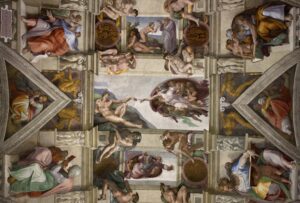
- Chapel Sistina — Sistine Chapel. Sistine Chapel — a former house church in the Vatican. Built between 1473 and 1481 by the architect Giorgio de Dolci, it was commissioned by Pope Sixtus IV, hence its name. Today, the Chapel is a museum and a remarkable Renaissance monument, also used for conclaves, during which cardinals elect the new pope. The Sistine Chapel Choir is a world-renowned professional Catholic church choir.
- Giardini Vaticani — Vatican Gardens. A stunningly beautiful place, recently opened to the public. Vatican Gardens The gardens cover a total area of over 20 hectares. The Vatican Walls bound the gardens to the north, south, and west. Most of the gardens are laid out and maintained by humans. A significant portion was created by papal orders during the Renaissance and Baroque eras. The best-preserved, "natural" part of the Vatican Gardens is the area between the Leonine Wall and the Vatican City Administration building. It is a dense thicket of various trees: pines, oaks, cypresses, palms, and others, covering this hilly terrain. Numerous roads and paths run through the gardens. In the western part of the Vatican Gardens is the Vatican Heliport—a special helicopter terminal for the popes (opened in 1976), connecting the Papal States with Rome's Fiumicino and Ciampino international airports.
- Vatican Grotte — Vatican Grottoes. The Vatican Grottoes are located beneath St. Peter's Basilica and are divided into chapels dedicated to saints, the tombs of kings, queens, and popes dating back to the 10th century. The holiest site is the tomb of St. Peter, built by Emperor Constantine in the 4th century. The Vatican Grottoes also contain the tombs of Pope Paul VI (1978) and Pope John Paul II (2005).
- Baldacchino di San Pietro — Canopy over the tomb of Saint Peter. This is Bernini's masterpiece: a colossal, 29-meter-tall canopy supported by four twisted columns, upon which stand statues of angels. The bronze for the canopy was taken from the Pantheon, after Pope Urban VIII ordered the dismantling of the structures that supported the portico's roof. It is the largest bronze structure in the world.
- Cathedra Petri — Throne of Saint Peter. The Golden Throne of St. Peter the Apostle. An impressive sight. It "floats" in the air because sitting on it is prohibited.
- La Pieta — Michelangelo's Pieta. The figures of the Virgin Mary and Christ were carved from marble by a 24-year-old master commissioned by the French Cardinal Jean Bilaire for his tomb. In the 18th century, the statue was moved to one of the chapels of St. Peter's Basilica in the Vatican. During transport, the fingers of the Madonna's left hand were damaged. In 1972, the statue was attacked with a rock hammer by the Hungarian-born Australian geologist László Tóth, who shouted that he was Christ. After restoration, the statue was installed behind bulletproof glass to the right of the cathedral entrance.
- Vaticano Egyptian Obelisk - Egyptian obelisk in St. Peter's Square. In the center of the square stands a 25.5-meter-tall Egyptian obelisk of pink granite, brought to Rome by Emperor Caligula in the year 37. During the reign of Pope Nicholas V (c. 1450), there were plans to move the obelisk to the square, but its large size prevented this. Only 150 years later did the energetic Pope Sixtus V succeed in moving the obelisk. The architect Domenico Fontana oversaw the move. The obelisk was placed on a wide, sturdy monolith, surrounded by a structure with winches and rollers, which were used to lay it along the road. The operation involved 900 workers, 140 horses, and 44 winches.
***return to section "Vatican"
 Vatican, Michelangelo, Saint Peter in the Vatican, Vatican grottoes, Vatican Gardens, Sistine Chapel, Raphael's Stanzas, Vatican Museums, tourism in Italy
You can submit your request by filling out the table, which will help you not to miss its main parameters, and we will immediately begin processing it, or by sending it in free form to the email address viaggidoroitaly@gmail.com or contact us at tel.+393467890070
Within 3 days, with the exception of requests marked URGENT, you will be sent a response to your request.
We wish you a pleasant stay in Italy!