

In the Italian capital, in Piazza Ostiense, stands a remarkable structure: the Pyramid of Gaius Cestius. This structure was built in 12 BC and is the tomb of the Roman praetor Gaius Cestius, who ordered his burial as a pharaoh. During his lifetime, he actively participated in the Nubian battles, so the Pyramid of Cestius is more reminiscent of the pointed pyramids of Nubia than Egyptian ones. However, the murals adorning the walls are Roman in style: they depict nymphs carrying vases and a winged Nike with flowers and ribbons.
The structure is remarkably well preserved, its exterior covered in marble and brick. The pyramid stands 36 meters high. In the 270s, it was built into the Aurelian Walls, which helped preserve its integrity. The pyramid can be visited on the second and fourth Saturdays of the month; guided tours are held at 11:00 AM; advance booking is required. The structure is located in the southern part of Rome, near the B metro station (Piramide) and the Roma-Lido train stop, Roma Porta S. Paolo.
In northern Italy, a submerged bell tower built in the 14th century rises above Lake Resia. The tower was submerged in 1950 during the construction of a hydroelectric dam. The project involved creating a dam to replace two villages that had completely sunk to the bottom.
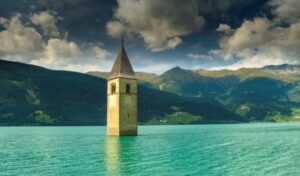
The water level in the reservoir fluctuates constantly, and at times only the top of the clock tower is visible above the lake. Due to frequent and strong winds, this spot is very popular with surfers. In the summer, pleasure boats ply Lake Resia, offering rides to anyone. And in December, when the lake freezes, you can walk to the bell tower on foot across the ice. A trip to the lake can be combined with a visit to Stelvio National Park, Italy's largest, and in winter with skiing, which is no less enjoyable than in Switzerland.
The most convenient way to reach the bell tower is by car. The nearest large city is Bolzano, located 75 kilometers to the southeast. Access is via the SS38 and SS40 motorways. You can also get there from Verona (249 kilometers) via the A22 and SS38, Munich (213 kilometers) via the A95, 187, 197, and 180, and Innsbruck (125 kilometers) via the A12 and 180.
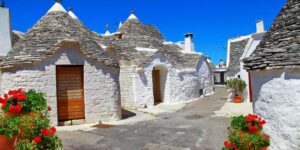
Alberobello has preserved trulli built between the 18th and 20th centuries. Today, they serve as shops and restaurants, and some are still inhabited by local residents. The town hall and even the Church of San Antonio are also shaped like trullos. The Trullo Sovrano, the only truly two-story building of this type, is also located here. There are approximately 1,500 such houses in the city, all of which are designated UNESCO World Heritage Sites.
The easiest way to reach Alberobello is by train from Bari. You can also drive to the city from Bari or Brindisi airport.
For centuries, wealthy Italians competed with each other, attempting to build ever taller towers to demonstrate their wealth. It was only in the mid-13th century that city authorities decided to limit the maximum height of family towers. The height of the Town Hall tower—54 meters—was adopted as the benchmark. Towers taller than 54 meters were to be dismantled to reach the established upper limit. The tallest tower that has survived to this day is the Torre Grossa. It is the only one permitted to tourists. From the roof of the tower, a beautiful panorama of San Gimignano and the surrounding area opens.
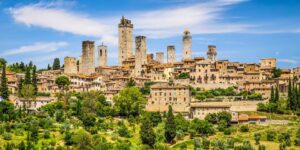
You can get to the city by train: from the north - the Milano-Bologna-Firenze, Firenze-Empoli, Empoli-Siena line; the Genova-Pisa, Pisa-Empoli, Empoli-Siena line. From the south: the Roma-Firenze line (change in Chiusi/Chianciano Terme), Chiusi/Chianciano Terme-Siena, Siena-Empoli line; the Roma-Pisa, Pisa-Empoli, Empoli-Siena line, or by car or by bus from Siena or Florence.
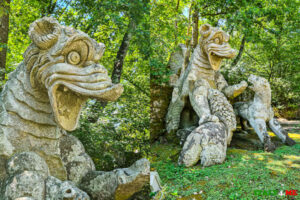
In Bomarzo, you can now see ferocious dragons, Sleeping Beauty, Hercules tearing apart a lion's jaws, three-headed mutant beasts, and a huge globe on an orc's head, topped with a miniature replica of the Orsini Castle. All the sculptures are made from giant boulders, giving the impression that they are growing out of the earth itself.
You can get to the park from Rome by train to Viterbo or Orte Scalo stations, and from there by bus to the park. It's more convenient, of course, to get there by car: from Rome take the A1 highway (68 km to the Attigliano exit) or from Viterbo take the Viterbo-Orte highway (20 km to the Bomarzo exit).
On the outskirts of Verona lies one of the most beautiful gardens in Europe, the Giusti Gardens. It is part of a 16th-century palace and park complex. The park is named after the Tuscan Giusti family, one of the wealthiest and most influential families in Italy. The garden is located at Via Giardino Giusti, 2. You can get there by public transport, taking bus number 72 to the Carducci stop.
In Umbria, you can see one of the tallest waterfalls in Europe, the Cascata delle Marmore, created by the ancient Romans. The combined height of its three sections reaches 165 meters. The "marble" waterfall gets its name from the calcium salts that give the rock from which the water falls a marble-like appearance. The waterfall is closed to visitors in winter, on Sundays, and on holidays. You can reach the waterfall by car or by bus from Terni.
***return to section Interesting facts about Italy
Attention!!! You can send your request in free form to: viaggidoroitaly@gmail.com
or contact us by phone: + 393467890070, +393492302664
The travel agency Viaggi D'oro will make sure your holiday in Italy is bright and unforgettable!