

It's hard to believe, but there is a musical genre in the world that is more popular than the ubiquitous pop. This is a Neapolitan song. By singing 'O Sole Mio' in unison, Pavarotti, Carreras and Domingo surpassed Michael Jackson in fame. Having included “Santa Lucia” in the repertoire, the first stadium was assembled. By performing “Come Back to Sorrento,” they turned the Three Tenors brand into something like Coca-Cola. Literally everyone - Mario del Monaco, Mario Lanza, Muslim Magomayev - sang in Neapolitan. Even Elvis Presley, the cowboy of pop music, - and he, in his own way, of course, covered Neapolitan hits, turning Torna a Surriento into Surrender.
The narrow cobbled streets of Sorrento
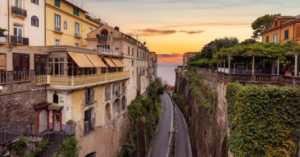
This very same "Torna a Surriento," or "Return to Sorrento," isn't all that old: it was first performed at the beginning of the 20th century, in 1902. The story goes that the then Italian Prime Minister came to Sorrento on vacation, and the local mayor—a plot utterly out of Gogol!—decided to "bribe" the prime minister with a new Neapolitan song (the purpose of the bribe was to open a post office in the city). Local residents, the De Curtis brothers, quickly wrote lyrics and selected a sweet melody, some musicians learned the song, and the first performance of this masterpiece took place under the Prime Minister's hotel windows. The official couldn't shake the tune, the post office in Sorrento opened, and the song became an immortal hit, outliving the politician, the mayor, and the De Curtis brothers. It seems that even today, most tourists come to the town on the Gulf of Naples to check in where the nightingales of humanity insistently invite them to return.
Historical Grand Hotel Excelsior Vittoria stands on the high shore of the Gulf of Naples
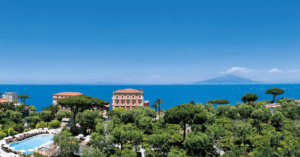 The Grand Hotel Excelsior Vittoria, where the Prime Minister stayed back in 1902, is alive and well and celebrating its 180th anniversary this fall. Frankly, if we were to return to Sorrento, as the song calls us, then first of all to this hotel. Imagine: on a high bank with a view of Vesuvius, Naples, and the setting sun, stand, just like the Three Tenors on stage, three houses. One is a perfect palace, another is a patrician villa, the third is an Alpine chalet, unexpected in these latitudes. The mansions are connected by a terrace. By calling the elevator, you can go down to the port - from there, boats leave for Capri, Ischia, Naples, and the Amalfi Coast. Behind the houses is a luxurious, five-hectare garden. At the depth of the garden is a swimming pool. And all this in myself in the center of Sorrento, in the main square, right on which there is a gate, and behind it there is a path leading to three houses.
Archaeologists claim that Emperor Augustus's villa stood exactly where the hotel now stands. And dig—you'll find a coin, a cup, or some other valuable. However, digging in Sorrento can yield many discoveries: the Phoenicians founded the city on a steep cliff, beneath which lies a romantic promenade, a narrow pebble beach, and beach terraces. Then came the Greeks, who named the settlement Sireon after the Sirens. Then came the Romans, followed by the Byzantines, Lombards, Saracens, Normans, Aragonese, and Turks. And everyone, it seems, longed to return to Sorrento, but few ever made it.
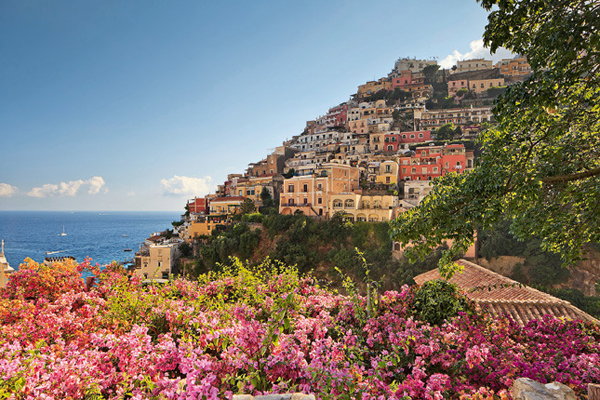
Driving from Naples along the Sorrentina Road—the road leading to Sorrento—you eventually emerge from the serpentine onto a straight stretch of highway running along a high, steep coastline. To your left are the mountains, to your right, the blue expanse of the Tyrrhenian Sea. Unable to tear yourself away from this magnificent beauty, you stop in a small "pocket," get out of the car, and stumble upon a vendor selling a distinctive local product: crushed ice mixed with limoncello, a liqueur made from thick-skinned Sorrento lemons.
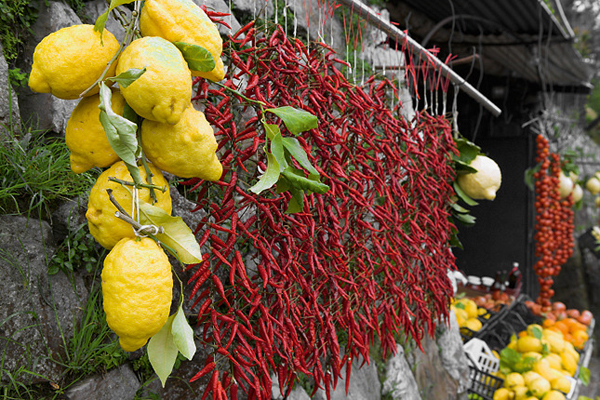
Just what you need in the heat! You buy a glass of ice for a couple of euros, stick a straw in it, walk to the edge of the cliff, and freeze: the first sip of the icy cocktail hits your temples, takes your breath away. The sight of Sorrento—the port below, the bell tower of the Basilica of San Antonio—starts your heart racing. You're almost home! Just a little more—a ten-minute drive through streets clogged with lazy vacationers, who, even in autumn, aren't particularly eager to cross the road.
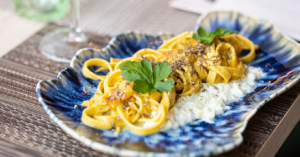 Sorrento cuisine is famous for its seafood dishes, handmade mozzarella, pork salami and grilled meat delicacies
The daily routine in Sorrento is as follows: mornings include sea bathing, strolls through lemon orchards, and philosophical reflections over breakfast with a view of Vesuvius, which opens up from every angle. Lunch at a pizzeria, followed by the obligatory restorative nap. And in the evening, local tuna marinated in pistachios, a whole fish baked under a pound of salt at the Bosquet restaurant. Tomorrow, a trip to Antonio's in the neighboring village, to the two-Michelin-starred Quattro Passi. What a tuna tartare he makes! And the bread!
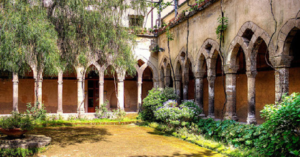 Monastery of St. Francis 14th century is included in the UNESCO World Heritage List
But you can also order a glass of local white wine right from the morning. Seagulls perched on the busts on the hotel terrace's balustrade will beg for focaccia, a musician will play "Torna a Surriento," and the maitre d' will tell the continuation of the never-ending story begun last year. Shura Cherkassky, the great American pianist, who visited here between concert tours, was forced to listen to the same catchy melody.
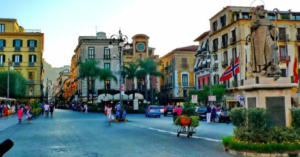
The Clock Tower in Piazza Torquato Tasso in the center of Sorrento
 Sorrento also offers an intriguing descent to the sea along echoing galleries carved into the rock during Nero's time. A couple of years ago, the municipality installed an elevator, but you have to walk along these galleries to truly experience the living antiquity! Huge lemon trees are everywhere—I've never seen anything like them anywhere else. A bay with fishing boats, friendly locals spilling out onto the promenade in the evenings, and a mandatory day trip on a tiny, surf-crawling boat to Capri or Ischia.
And then there's the journey to the ruins of ancient Paestum along the most beautiful road in the world, past Amalfi, Ravello, and Positano. And the eternal return to Sorrento. It was here that Enrico Caruso, photographed for the last time in his life in Piazza Torquato Tasso, sang along with the de Curtis brothers the words to the simplest, most sentimental, and yet most truthful song in the world, "Return to Sorrento."
***return to section Amalfi Coast
 tourism in sorrento, Travel to Sorrento, Sorrento, Sorrento cuisine, Sorrentine locksO, monasteries of Sorrento, Sorrento hotels
You can submit your request by sending it in free form to the email address viaggidoroitaly@gmail.com or contact us at tel.+393467890070
Within 3 days, with the exception of requests marked URGENT, you will be sent a response to your request.
We wish you a pleasant stay in Italy!